The Young Investigator Network is the platform and democratic representation of interests for independent junior research group leaders and junior professors at the Karlsruhe Institut of Technology.
Peer Community
Representation of Interests
Professional Development
Academic Leadership
Individual Support
Funding Opportunities

Artificial intelligence (AI) can play a key role in the energy transition. To ensure its reliable application, its methods must be transparent and comprehensible. This is the goal pursued by the Helmholtz Investigator Group “Data-Driven Analysis of Complex Systems” (DRACOS), led by Tenure-Track Professor Benjamin Schäfer, which was evaluated and rated by KIT’s Executive Board as “extraordinarily successful.” Schäfer’s goal is to make AI models used to analyze large volumes of data from energy systems more transparent. Until now, it has often been unclear which factors an AI uses to predict household energy consumption.
DRACOS group
Inside cells, ribonucleic acids (RNA) and proteins form distinct membrane-less droplets. These biomolecular condensates act as organizational hubs, supporting a wide range of cellular functions from gene regulation to stress responses. By combining experimental analyses with deep learning to determine which RNAs tend to cluster, researchers around Miha Modic identified a previously unknown RNA class active during early development. Their results also provide a conceptual and mechanistic framework to interpret pathogenic condensates in disease.
Press release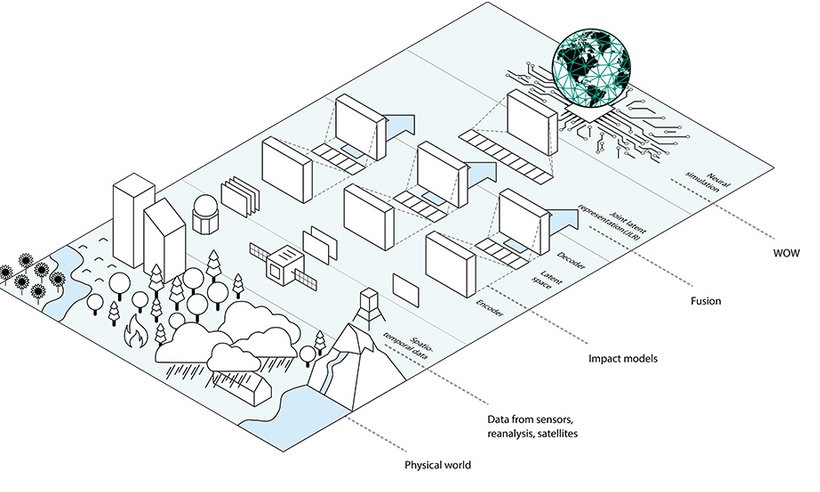
Wildfires, floods and droughts: a new artificial intelligence (AI) from KIT promises to be a game-changer in providing more precise, faster, and energy-efficient predictions of such events. In the "WOW - a World model of Our World" project, researchers will develop an AI world model that combines multiple specialized AI sub-models through shared “latent spaces”. "Modern AI methods can not only cost-effectively imitate physics-based simulations, but can even learn correlations directly from observational data," says project coordinator Peer Nowack. The Carl Zeiss Foundation is funding the project with six million euros.