
Cool Tree - The cooling potential of city trees at the local scale in parks and streets

 Our collaboration emerged from a shared interest in understanding how urban trees influence local thermal comfort — not at the scale of satellite pixels or city districts, but at the scale that people actually experience. Within the Young Investigator Network, we realized that our groups, based at ITAS and IPF, approached similar questions from different angles: one rooted in ecology and resilience, the other in geoinformatics and heat adaptation. Recognizing this overlap, we decided to combine our strengths in an interdisciplinary pilot: studying the cooling effect of individual trees directly on Campus South.
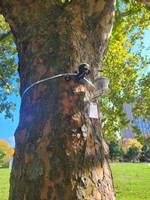
In CoolTree, we monitor twelve Platanus x hispanica individuals growing under contrasting environmental conditions: some in open, park-like areas with generous rooting space, others in more constrained, street-like settings. Each tree is equipped with a digital dendrometer that records radial growth every ten minutes. Around them, we installed four weather stations, eight soil-moisture sensors, and more than twenty air-temperature and humidity sensors at human height. Although the technical part of the project mainly involved purchasing and installing sensors, the scientific idea behind it is intentionally interdisciplinary: combining ecological insights on growth and water stress with fine-scale atmospheric measurements and spatial data. This approach allows us to build a dataset that links tree physiology with thermal comfort in a way that neither discipline could achieve alone. The installations were completed jointly in spring 2025, and the system is designed as a multi-year monitoring setup.
We are still at the beginning of data interpretation, but the temperature measurements from summer 2025 already show clear patterns. Even though the season was relatively mild, canopy shading produced measurable differences between sensors under trees and those exposed to clear sky. These contrasts are most visible during warm afternoons and smaller heat events, with a maximum temperature difference of around 6 °C and mean differences of roughly 2 °C during warmer periods. While the dendrometer data is not fully processed yet, we expect to observe known physiological patterns: rapid expansion during rainfall, temporary shrinkage during dry spells, and pronounced diurnal cycles. With our long-term setup, we will be able to compare these signals across contrasting environments — something that has not been done at this fine spatial scale at KIT before.
Several students at Bachelor, Master, and PhD level are already involved, contributing to data cleaning, modelling, and interpretation. As more extreme weather events occur in future summers, we expect the system to capture stronger contrasts in temperature and tree response.
Ultimately, the goal of CoolTree is to build a robust, interdisciplinary dataset that helps us understand how individual trees contribute to local thermal comfort — and how environmental stress, in turn, shapes their ability to do so. With this knowledge, we aim to support more informed and equitable decisions for urban planning at KIT and beyond.